A tree on top of a hill with a tire swing hanging off its branches. The sunset is on the left. This is the final shot of Toy Story 5. Before this final shot, the "camera" pushed into it from a farmhouse as a horse walked slowly in the backyard. This followed a faded transition from an extreme long shot of two young girls playing together in the front yard of a yellow house. The extreme long shot of the house comes from a continuous push-out from the girl's bedroom window. From the shot inside the window to the tree, emotional brass music plays.
What is this sadness the scene creates? It feels like taking a deep breath of sadness, but not an ambivalence of both happy and sad. This scene lasts only for a few seconds, but it captures a nostalgic poignancy. There's also a sadness to this scene that's hard to describe. It's not heartbreaking; it's just sadness. It doesn't summarize the whole movie in just a few seconds, but it really stands out. Maybe the final shot is a manipulative scene to trick one into thinking the film is emotional when it's not? But one remembers being sad at another scene.
When thinking about the movie, there's an indescribable sadness. It's not from anything the film does, but it's just somehow there. The most explicit way it shows up is in the final scene with the tree.
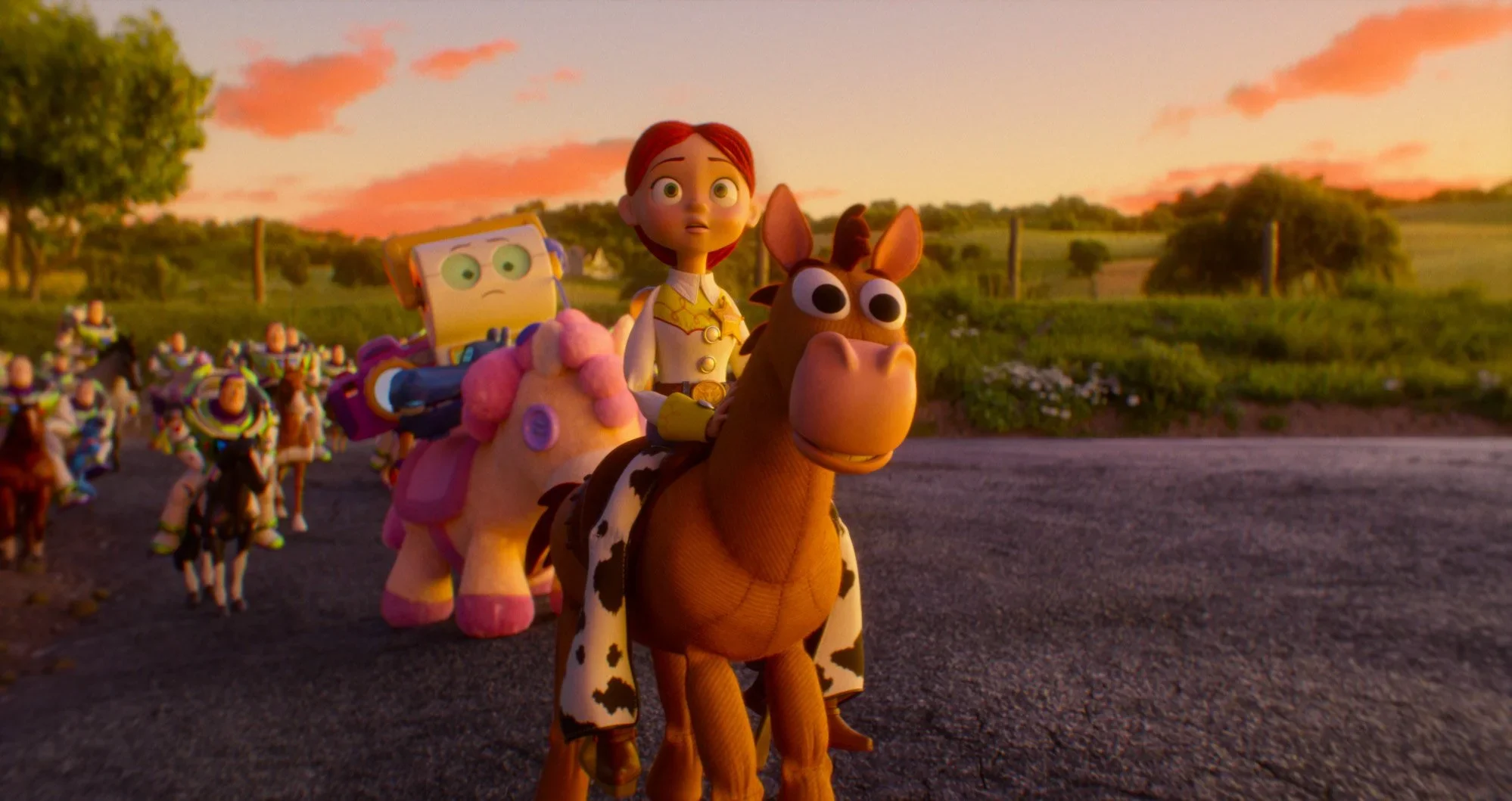
Another way it shows up is through its clever premise. In Toy Story 5, Jessie, the cowgirl rag doll, and the other toys are introduced to electronics. Electronics are taking children away from toys, as kids spend more time on them and lose interest in playing with toys. This issue is very real, and from a toy's perspective, it must feel like a demise. The film ends happily, with electronics and toys becoming friends. Jessie makes her way to a farmhouse, which was her former home when she was owned by a different kid. Woody and Buzz go to rescue her. Meanwhile, a group of brand-new high-tech edition Buzz Lightyear action figures make their way to the farmhouse. The Buzzes lead the climax into a mix of neat and chaotic chaos.
When reflecting on the film, it's really hard not to think of this movie in ways other than itself. It's hard not to think of the film’s place in the Toy Story film series. Do the four previous Toy Story films being so exceptional make this one, which isn't as good, feel subpar? A sequel being inferior or less fresh and ambitious than its predecessors doesn't make it bad. This film is less fresh and ambitious when compared to the previous four, specifically thematically. Its story also doesn’t feel like a milestone in the toy gang's lives like the previous films do. This film doesn't explore as much or as profoundly the meaning and purpose of being a toy. And its ending and overall story don't strike as strongly as the previous four.
Does the final scene only feel indescribably sad because it’s kind of a reminder of Jessie’s backstory scene in Toy Story 2? Does nostalgia for the previous movies blind one from fairly judging this movie? Is one misremembering those films? Does the sadness actually come from the series being 31 years old, and the voice actors' voices sounding more gravelly as a reminder of age and change? Maybe the sadness comes from the number of voice actors who died from the first film to this one, and having to replace them with new ones as another reminder that everyone's getting old and things change?
But maybe the problem isn’t with the movie, but how the present-day world makes people respond to movies, among other things. Like the internet itself, where online information is a flash flood- coming super fast without any time to calmly reflect on something. Has this increase in online information make one put information about the film's studio and the box office into mind when judging this? Has the post-COVID world changed how humans see and function? Making people more dogmatic? Does learning more behind-the-scenes about films ruin the magic of the trick, to the point where you overthink as you watch movies instead of just watching them? Does learning about the film industry ruin a movie to the point where you think about the industry as you're watching a movie instead of just watching the movie? Does the rise of frenetic energy in recent animated films keep this film's reasonable amount of frenetic energy from saying all it has to say about this concept? Or is the concept so absolute that it can't be discussed in less than two hours? If so, why is there a sadness?
Or, again, is the problem the internet and how it makes everything reactionary, too fast, and uncalm? Where every title is clickbait, and every word spoken is excessive hyperbole.
So much reflection of the movie is chaotic thoughts. It’s hard to tell if the kids feel too cutesy, or if their being hammy, or if thats how kids are.
Maybe one isn't in the right mindset to review a film? A calm mindset they once had recently is now gone because their world has changed. Films should make people think, but not obsessively think as they're watching. Just as the toy characters in the film are scared of technology, in the real world we should all be scared not just of generative AI, but of how fast the internet is, and whether it has ruined our ability to breathe and write. We can retrain ourselves to feel peace of mind, not to obsessively think, as the internet taught us to, until there's just peace. Just to watch a film and enjoy it- Hollywood didn't change storytelling to the point where that's gone; the internet changed people's minds to the point where some of them can't do that. But they can if they just watch movies to watch movies.
